There are some things that resist being done neatly.
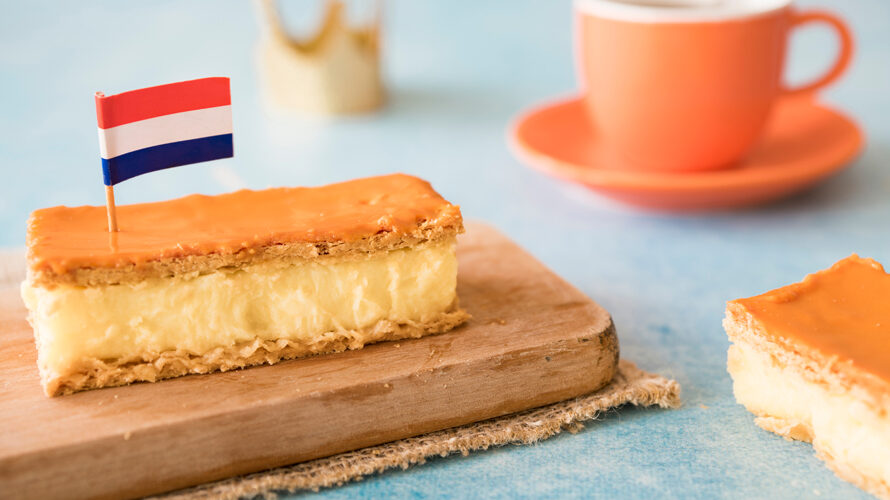
I am fond of sweet pastry-related offerings—to put it mildly. So, on my many trips to Groningen, when I saw something that looked (and largely behaved) like a vanilla slice, I had to give the tompouce a go. But unlike the vanilla slice eating of my youth, this would probably have to be done in the presence of Dutch colleagues. I already felt like the slightly scruffy Englishman in the smart cafés of the university quarter, and smearing my face/beard with cream and flakes of pastry was not quite the look I was going for while trying to sort a bilateral Erasmus agreement. But to be honest, there was no question what would happen: appetite won. Therefore, mess won: and we still signed the agreement. I think my colleagues knew: there is no other way to eat a tompouce other than ‘route one’—embrace the mess.
In a segue almost as clumsy as my patisserie consumption, I think there may be something to learn from this about learning and thinking. We tend to present thinking, and the learning process, as if it were orderly. A question is posed, arguments are assembled, a conclusion is reached. In teaching, we often reinforce this structure: introduction, development, resolution. It gives the impression that thinking proceeds cleanly, from one step to the next. But that is not how it usually feels from the inside. It misrepresents the phenomenological truth.
Thinking is often hesitant, recursive, often barely coherent. We circle around ideas, try things out, get lost and maybe found. The structure appears afterwards, if it appears at all. The lived experience is much closer to trying to eat a tompouce without making a mess. The problem, however, is not that thinking is messy. The problem is that we keep trying to make it look as if it isn’t.
This has consequences for teaching and learning; and might explain why I am so hostile to neat diagrams with coloured boxes in them. When we design learning around neat outputs, we risk encouraging students to prioritise presentation over process. If it looks coherent, if it follows the expected structure, then it passes. Whether the thinking that produced it was careful, sustained, or even particularly engaged is harder to see—and so easier to ignore. It also makes students potentially feel bad that their own thinking is not like the image on the screen – but is rather more like a collapsing cream horn…
AI makes this more visible, but it is not the cause. If anything, it simply produces very convincing tompouces: beautifully assembled layers that may or may not reflect the process that led to them. What gets lost, in all of this, is the experience of thinking as something we do, not just something we display.
Frameworks contribute to this in subtle ways. Bloom’s taxonomy and its many descendants are appealing precisely because they impose a spatial order on something that has no natural geometry. Learning is made to look like movement upwards—from remembering to creating—as if these were distinct stages rather than entangled aspects of the same activity. But anyone who has tried to learn something properly knows that these processes are present from the beginning, and in no particular order: clumsy, overlapping, and often simultaneous.
From the learner’s perspective, this matters. The confusion, the wrong turns, the half-formed ideas that cannot yet be articulated: these are not signs that something has gone wrong. They are signs that learning is actually happening. A framework that eliminates the mess risks eliminating the thing itself- and misleading us into thinking we have got it wrong somewhere, that we are on the wrong path.
From the educator’s perspective, it poses a more uncomfortable question. When we reach for these frameworks, who are they really for? Do they help the student to think, or do they help us to feel that something essentially unruly is under control? The coloured pyramid sits comfortably on a slide. It reassures. It gives the impression that learning is being managed. But understanding does not lend itself easily to being managed so neatly.
This is not an argument against structure. Structure matters, of course. But perhaps it is better understood as scaffolding: as temporary, supportive, and ultimately removable, rather than as taxonomy: permanent, defining, and too easily mistaken for the thing itself. (I resits a moon-finger Buddhist story here, only through great effort!)
Part of what escapes these frameworks is what Michael Polanyi famously described as tacit knowledge: the sense that “we know more than we can tell.” Much of thinking lives here: in half-formed judgement, in feel (vibes, if you like), in the gradual refinement of attention. It cannot always be cleanly articulated, and it certainly cannot be reduced to a set of stages.
There is a useful contrast here with the kind of appetite described by A. J. Liebling in Between Meals: An Appetite for Paris, a delight in excess, in exploration, in following taste rather than efficiency. His writing is, to some, excessive and occasionally indigestible, but that is part of the point. It refuses to reduce experience to something tidy. It lingers, wanders, returns – it is like the meals and wines he writes of – it has structure, but also is open to a derivé.
As with sprawling French meals, so with pedagogy… If everything is made clean, efficient, and easily consumable, we risk losing the very conditions under which serious learning, knowledge and creativity occurs. Some things need to be struggled with – Higher Education is hard,. Some ideas only become clear after they have first been confusing – what may seem obvious to the teacher was once perplexing and seemed preposterous or unfathomable. Some forms of knowing/learning depend on the willingness to push on relentless in the face of something that does not yet make sense.
None of this is especially comfortable, and may not seem very efficient. It is difficult to scale and hard to measure. But that is the truth of the game we are in here. When we pretend otherwise, learning, students, and scholarship all suffer.
If we insist that thinking must always present itself in neat, well-formed layers, we may end up producing something that looks convincing but lacks the texture of real engagement.
Your ideas, or teaching slides, may look like a perfectly assembled pastry. But if no cream ever spills on our face, or pastry ends up on our clothes, nothing much has been learned.


Leave a Reply