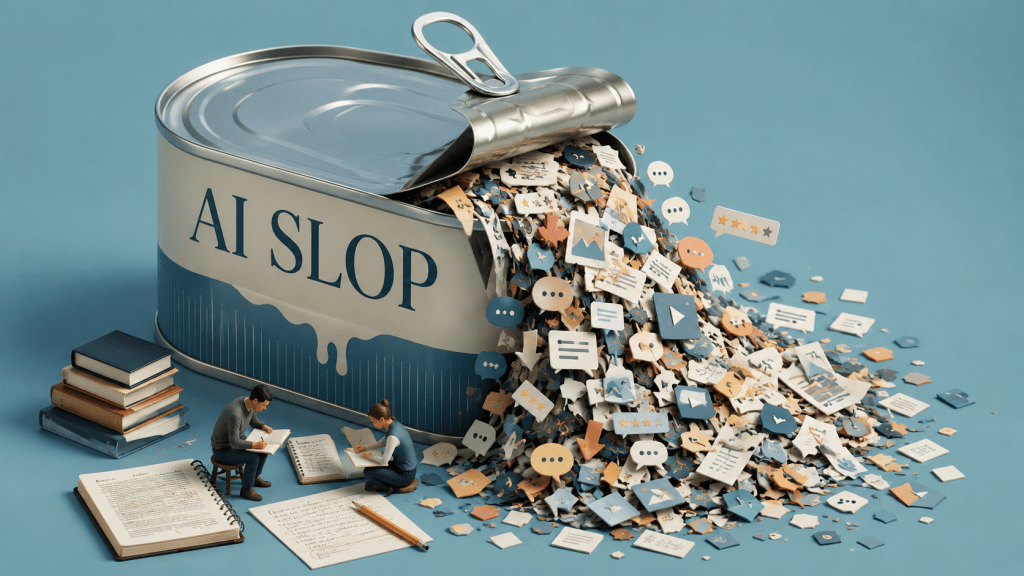
How can we teach and work in what Adam Aleksic calls our ‘hypermediated reality’?
I spoke today at EdTech World Forum in London on Education in an Age of Brain Rot, AI Slop and Cognitive Offloading.

The title is not elegant, like my usual efforts… But it tries to capture the feeling many of us now have about the internet in general, and AI in particular. Cognitive offloading sounds much more recent and tech-specific a term than it really is – I like this line from Evan F. Risko, Sam J. Gilbert’s piece in Trends in Cognitive Sciences, (Volume 20, Issue 9) :
“Cognitive offloading can be roughly subdivided into actions that offload cognitive demands onto-the-body and into-the-world.”
They start with the example of turning one’s head to see a rotated image, as an example of the former, or for the latter we might use a computer – or sketch in a notebook – but it is hardly a new thing. But along with the other two terms – which are more contemporary – this triad represents the basis of a contemporary moral panic – these all sound pretty bad! The location of much of this anxiety is education. Just because this is culturally familiar as a moral panic – does not mean that there are not real problems which educators have to deal with.
Brain rot is not really about brains
“Brain rot” was Oxford’s Word of the Year in 2024. It is a striking phrase because it sounds unserious and serious at the same time. It belongs to meme culture (and its general use belies its more specific, self-referential and ironic self-mocking use in online subcultures), but it also carries when used outside of its main audience/context, to wider more mainstream audiences, genuine fear: that our capacities for attention, patience, judgement and discrimination are being thinned out by the online environments we inhabit. It is also, of course, a sneer. “Rot” has clearly a judgemental element. Like “bed rotting”, it makes something sound worse, more shameful, more decadent. A “duvet day” and “bed rotting” may look rather similar from the outside, but the moral framing is completely different. One is rest; the other is decay.
I do not think educators should use “brain rot” as a way of talking about students. It too easily becomes a moralising and lazy complaint about ‘young people these days’ It becomes another way of saying that the young are failing to become the sort of people we (often while knowing, deep down, that this is not true) imagine ourselves to have been. Nonetheless the phrase is worth taking seriously as a cultural symptom. It refers to the fear that the mind is being nudged away from certain forms of attention. Nudged and habituated into skimming, reacting, sampling, scrolling, half-knowing. It is the anxiety that our inner lives are increasingly shaped by systems designed to interrupt, stimulate, monetise and move us on – to put it another way: we are being harvested for profit. The challenge for educators is to avoid the panicking and concentrate on what we actually think matters – how to make our bit of the world (be that classroom, VLE site, or tutorial meeting) one that promotes and rewards actual thinking and nurtures concentration and an actual appetite for disciplinary engagement.
AI slop and the epistemic environment
‘AI slop’ is not simply poor quality content. – and we don’t need AI to make that. Indeed, anyone familiar with the history of UK tabloid journalism will know that we did not need generative AI to produce distortion, outrage, fabrication, simplification or intellectual junk. The internet itself was not a realm of pure scholarly seriousness before the arrival of large language models. The problem predates AI. It is tied to older questions about media, attention, platform capitalism and what Cory Doctorow memorably calls the “enshittification” of digital spaces: the gradual degradation of platforms as they are optimised for financial extraction rather than their stated purpose.
AI does however scale up the production of bad content, and of certain types of it. AI slop is content produced without judgement, care, authorship, responsibility or any meaningful relation to truth. It is often so preposterous that people might not believe it if they were to interrogate the details – but it poisons the well. It shifts conversations. N Malik’s piece ‘With ‘AI slop’ distorting our reality, the world is sleepwalking into disaster’ is worth a read. While she notes how it seems to particularly feed into right-wing fantasy projections, she also goes on to note: ’Most of the time, AI slop is just content-farming chaos. Exaggerated or sensationalised online material boosts engagement, giving creators the chance to make money based on shares, comments and so on.’
She is correct. Beyond our initial response to the term, it is worth noting that the phenomena are not just the weird, uncanny images of a many-fingered Jesus that someone’s grandparent shares on Facebook. It is the SEO article, the fake review, the synthetic essay summary, the automated policy text, the plausible blog post, the generated answer that sounds like it knows more than it does. This last phrase is precisely the problem. The danger is not only that AI-generated material might be wrong. The danger is that it may help produce an environment in which the distinction between thought, content, answer, summary, position and argument becomes increasingly blurred. It is a nihilistic attitude to actual truth.
Dead internet theory is useful here, even if taken more as direction than as literal reality (yet). It captures the suspicion that more and more of what we encounter online may not be humanly intended in any strong sense. Not written, but generated – to influence us toward certain purchases, voting patterns, or to normalise certain patterns of discourse, pricing, or behaviour. The epistemic challenge is not simply that students may encounter falsehood. It is that all of us may come to inhabit an environment in which caring about the difference between the true, the plausible, the generated, the repeated, the inferred and the understood becomes harder. This is where Nietzsche’s image of nihilism as the “uncanniest of all guests” still feels useful. The uncanny guest does not arrive looking monstrous. It arrives looking familiar. It sits at the table. It speaks our language. AI slop is uncanny in that sense, and less every day in the ‘uncanny valley’ one. It reads like content. It may even be useful content. But it can also encourage a posture of indifference – a weary (and all too passive) shrug regarding the actual veracity of claims.
Cognitive offloading is not the enemy
Of course, we have always used tools to think – as I mention above. Thanks to Professor Miles Berry for reminding me of the Plato passage, from the Phaedrus:
And so it is that you by reason of your tender regard for the writing that is your offspring have declared the very opposite of its true effect. If men learn this, it will implant forgetfulness in their souls. They will cease to exercise memory because they rely on that which is written, calling things to remembrance no longer from within themselves, but by means of external marks.
What you have discovered is a recipe not for memory, but for reminder. And it is no true wisdom that you offer your disciples, but only the semblance of wisdom, for by telling them of many things without teaching them you will make them seem to know much while for the most part they know nothing. And as men filled not with wisdom but with the conceit of wisdom they will be a burden to their fellows.
The technology being condemned here is: writing. Offloading has had a bad press before! Unless we want condemn writing, books and all other forms of offloading, the simplistic argument that “AI lets students offload cognition, therefore AI is bad” will not do. What we should ask instead is which cognitive work matters enough to keep within the learner’s own struggle? What is the struggle students should be wrangling with?
Do we need students to waste energy on every mechanical sub-task if that energy could be directed toward better judgement, more thorough analysis or more careful synthesis? They might even have more time to read! However, of course, some forms of offloading remove the very activity through which learning occurs. We need (and it will vary by subject, module, level and wider context) to know the difference.
Thinking is not just producing an answer
Sometimes academics talk as if thinking is demonstrated in the final product: the essay, the presentation, the report, the exam script, the artefact, the portfolio. Those things should demonstrate that thinking has taken place, of course. But it is not the thing-in-itself.
If a student uses a system to bypass the unresolved, messy, uncomfortable process during which their work takes shape, something is lost. Not just evidence of learning but something more profound: the transformation by which the person who hands in the work is not ht person who began it – the incremental acquisition of learning.
What does assessment teach?
In universities, assessment is not just a measurement system. It is one of the most powerful messages we give to students. Assessment tells students what matters – or at least what their tutor values/wants from them. It lets them know what kind of attention is rewarded. It tells them whether learning is primarily recall, performance, compliance, risk-management, technique, creativity, judgement, or something else entirely! The AI question cannot be solved by detection tools or academic misconduct policies alone. Those may have a place, but they do not address the design question. If an assessment can be completed well by a student who has not meaningfully thought, then the problem is not only with the student or the technology: the problem is with the assessment. Generative AI exposes weaknesses that were already there.
Some assessment has long rewarded a certain stylistic compliance material more than the development of thinking. Some tasks have been too easily satisfied by fluency, structure, citation and tone. Some have assessed the appearance of understanding rather than the activity of understanding. While AI did not create that problem, it has made it much harder to ignore.
That does not mean every assessment must become elaborate, personalised, oral, authentic, reflective, multi-stage and impossible to game. We should resist turning assessment into a theatre of suspicion. Students do not need an arms race of surveillance, viva traps and defensive design. But we do need to ask better questions – and there are lots of people trying to do this, and guidance on designing for the process, not just the product. .
If we reward only the answer, students will quite reasonably seek the most efficient route to the answer. If we reward the polished product detached from the labour of thinking, we should not be surprised when tools that produce polished products become irresistible. If we assess as if learning were mainly the delivery of a correct-looking output, we train students into that same view of learning. And then we blame them for learning exactly the lesson we have taught them!
The role of the educator
But before we think that redesigning our assessment is the end of thinking about this – I first want to say something about teaching itself. Students notice how we relate to our material. They notice whether we are still interested in the subject (or at least can do a passable impression of being so). They can do a pretty good job of seeing if the person at the front of the class thinks that this subject that they have dedicated substantial temporal and financial resource towards is actually the most interesting thing you could spend your finite time studying!. Learning is not only through instruction but is through example, atmosphere and intellectual culture. Through modelling the best of the discipline.
If we want students to care about understanding or thinking, they need to encounter people who visibly care about understanding – who are rapaciously curious. If we want them to tolerate uncertainty, they need to see uncertainty handled without panic. If we want them to revise their thinking, they need to see revision as a sign of seriousness rather than weakness. This does not mean returning to some romantic, never-having-existed past idea of the charismatic lecturer. Nor does it mean ignoring structural conditions, workload, class size, precarity, regulation or the pressures under which both students and staff work. However it does mean that education cannot be reduced to mere content delivery. The educator’s task is not simply to transmit information, especially in a world overflowing with generated information-shaped material. The task is to cultivate the conditions in which thought becomes possible, desirable and to show what this looks like.
Against rot, for appetite
So perhaps the response to brain rot is not moralising; not merely detection; the response to cognitive offloading is not a blanket refusal of tools. A better response is a renewed seriousness about thinking.
Not ‘thinking’ as a vague graduate attribute. Not thinking as a slogan (like ‘critical thinking’ is often used as). Not thinking as something we assume happens somewhere in the background while students complete tasks. But thinking as an activity we design for, model, assess and safeguard. This means being clearer about what kinds of struggle are educationally necessary. It means designing assessments that requires judgement, not just retrieval. It means helping students see that the difficult part of learning is not an unfortunate obstacle on the way to the answer. The difficult part is often the point. The elements that we used to presume took place off-stage (as it were) might now have to come into the limelight – be it via live mini-Vivas, writing in class time, or collaborative class critiques of AI – a new motto might be ‘show me the thinking’.
Brain rot, AI slop and excessive cognitive offloading all are, in their own ways, forms of cognitive passivity. (A bad lecturer who bores the audience does the same thing.) Education’s answer should be neither nostalgia nor panic. It should be the cultivation of appetite: the desire to understand, the willingness to tolerate the difficulty, and the stubborn refusal to let thinking become someone else’s job.


Leave a Reply