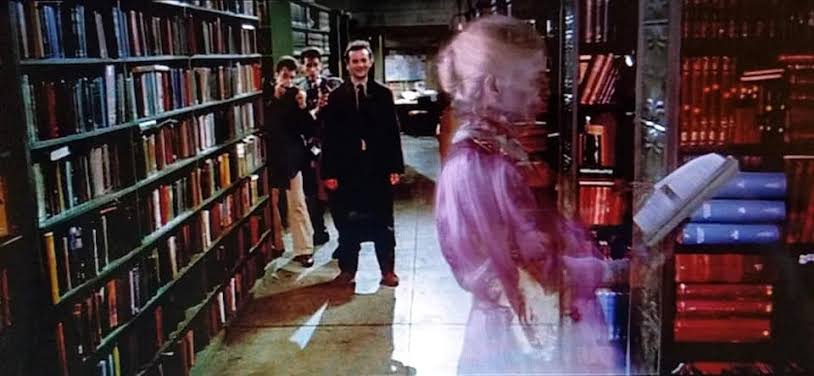
I have been thinking about libraries. Not in any systematic way, obviously, but in a wandering-about-rather-happily-confused sort of way. More specifically, I have been thinking about the book next to the book I was there to find. I have spent a lot of time wandering around university libraries looking for an actual physical book. Sometimes it isn’t there – sometimes it is – but despite libraries not being semi-conscious phenomena of Terry Pratchett’s Discworld, where the tomes of Unseen University might actually fly at you, odd things can happen.
There were other books near the one you had written on your scrap of paper – books that looked interesting, or confusing, or just seemed like they were looking at you. Maybe that last one was just me, but I was a philosophy undergraduate in the late 1980s who had read too much H. P. Lovecraft. This might explain, in part, why my PhD took so many aeons. Nonetheless, I was thinking about this experience recently, and about the amazing books I found – or which found me – by accident, through this serendipitous process.
I wrote recently about eating the tompouce and the problem of pretending that learning is much tidier than it really is. We draw curricula as orderly diagrams, arrange learning into levels, align outcomes with activities and assessments, and then seem faintly surprised that the actual experience of coming to understand something involves confusion, repetition, inexplicable leaps, blind alleys and occasional moments where something suddenly makes sense while you are doing something else entirely.
You are looking for A. You encounter B. B turns out to change what you think about A. Or C. Or, occasionally, a whole alphabet of apparent sense collapses into cognitive chaos. Jennifer Nutefall and Phyllis Ryder have written about The Serendipitous Research Process, and I would commend this piece – and their other work on the topic – to people well beyond librarians and writing tutors.
They suggest that many academics rely quite heavily on serendipity in their own research, but are strangely reluctant to talk about it:
Serendipity is a method of research that many academics have incorporated into their own information seeking behavior. Yet there is still a stigma attached to serendipity and its role in the research process.
— Nutefall and Ryder, The Serendipitous Research Process, p.19
I agree, and think we need to be more open about how leaky and weak many of our frameworks for advancing understanding really are. I also want to forestall one obvious concern about serendipity. Serendipity isn’t just randomness. If I empty the contents of a skip onto the seminar-room floor, I have certainly introduced unpredictability into the curriculum, but probably not improved the module. Although, now I think about it, good teachers would probably find something in the trash to talk about. But serendipity is not just found-object improv. We notice the not-sought book on the shelf because something about it catches us. The title, a question, a half-thought, an irritation, or some bit of barely realised thinking already simmering inside us.
Which takes me back to something I have worried about before: our slightly desperate educational will-to-system. On one hand, we want programmes to be coherent. I have spent some of my professional life telling people about constructive alignment, curriculum mapping and the desirability of students having at least some idea what the hell is going on. On the other hand, this has often felt a little suspect. It can feel perilously close to limiting innovation, and regulating out the exciting, accidental and personal things that often make learning actually work.
This all makes me even more uncomfortable in a digitally-mediated university.
Digital systems are magnificently good at finding things. I type a title into a library search box and the title appears. I follow a DOI and the article appears. Increasingly, I ask an AI system about something and receive a tidy summary, together with suggestions for what I might want to know next. This might seem miraculous compared with some of the scholarly experiences of my youth, which included filling in little paper slips and waiting several days for somebody to retrieve a journal from a basement. Dare I even mention microfiche? But perhaps these systems are a bit too good: too tediously specific and efficient. They rely on us knowing what we are looking for – even when we don’t know that we don’t know what we are looking for.
This is not an argument for smashing the VLE and the library system and sending students into the woods. (It’s not an argument for not doing that either.)
For now, though, I want to be more modest. What if, when we design programmes, we deliberately ask: Where are the opportunities to stumble across something?
Perhaps students looking for one library book should sometimes be asked to look at the books around it and take out one they had never intended to read.
Perhaps a reading list needs the occasional inexplicable item on it.
Perhaps we give students a digital collection and tell them to browse it for twenty minutes without a research question.
Perhaps they bring something into class that they have encountered elsewhere – a podcast, painting, TikTok, novel, newspaper story, conversation in the pub – and have to explain why it has become attached, however awkwardly, to what we are studying. Or why some vague parallel thought in their head has connected it to a conversation we had three weeks ago.
And serendipity needn’t be stubbornly analogue either. I once ended up going to see an Australian comedian talking about existentialism partly because of what I described at the time as an incident of digital serendipity. A podcast led to a Facebook post which led to a theatre visit which led, eventually, to me writing about teaching and comedy.
The internet is perfectly capable of giving us the unexpected. We perhaps just need to stop designing digital education entirely around frictionless delivery. We don’t need to be friction-maxxing to draw something useful from this.
Of course, “deliberately designing accidental encounters” starts to sound both self-defeating and a bit cringeworthy if we push it too far. We need to be wary of turning serendipity into another thing to be mapped, audited, scaffolded, quality-assured and placed in Week 6 between the formative quiz and the employability activity. Perhaps we don’t even need to use the strategies I mention above – although they are obviously excellent ideas. Maybe the more important thing is simply to leave some room.
If we must have neat systems – and, annoyingly, we probably must have at least some of them – let’s at least not make them so airtight and efficient that they leave no room for leakage, accidents, wrong turns and serendipitous encounters with reality.
The question at programme design is not how we can make serendipity happen. perhaps it is: Have we left anywhere for it to happen?


Leave a comment